Introduction to the SMTP Server
What is an SMTP server and what is it used for?
A SMTP server is a key component in the email sending process. Specifically, it is a server that handles the routing of your messages to the recipients' mail servers. Instead of sending an email directly from your own server to the final recipient, you go through a server that manages the transmission, routing, and technical compliance of your messages for you.
This relay acts as a reliable intermediary between the sender and the internet network. It handles crucial functions such as:
The management of dispatch queues,
The retry attempt in case of temporary failure,
Application of authentication signatures (such as DKIM or SPF),
Error tracking and deliverability statistics.
For companies, going through this intermediary professional allows for increased reliability, security, and performance. This avoids overloading one's own internal server while also complying with the standards imposed by email providers such as Gmail, Outlook, Yahoo, etc., which filters more and more strictly unauthenticated or misconfigured emails.
SMTP Server SMTP Operation
Email is an indispensable tool for modern communication. Whether for personal exchanges, automated notifications, or strategic professional communications, we send and receive emails daily. This apparent simplicity actually masks a sophisticated technical infrastructure. One of the central elements of this architecture is the SMTP server protocol (Simple Mail Transfer Protocol), which plays an essential role in routing messages from one server to another. This protocol, often invisible to users, is at the heart of how email works.
In this article, we invite you to discover what this protocol is, an SMTP server, how it actually works, and why it is essential to guarantee the reliability and speed of your email shipments. As the volume of exchanged emails has exploded—especially with the automation of marketing campaigns and transactional messages — the stakes of security and deliverability have become crucial. This is why, for a few years now, the main Internet service providers (ISPs) and messaging services have considerably strengthened the email security measures. The goal: to better combat fraud, phishing, and identity theft, while ensuring a reliable and secure user experience.
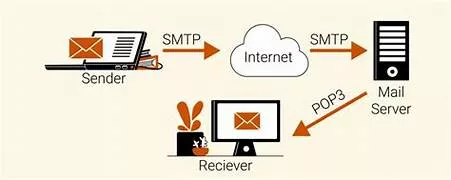
To understand the SMTP server Efidem, it's useful to visualize the process of sending an email:
Sending message: You compose an email and click «Send.» Your email client (like Outlook, Gmail, etc.) connects to a server to initiate the sending.
Initial transmission: Your email provider's server receives the message and examines the destination address.
Server relay: If the recipient is not on the same server, the message is relayed through several intermediate servers until it reaches the destination server.
Final delivery The recipient's server delivers the message to their inbox.
Each step of this process uses SMTP commands to ensure the message is correctly transmitted and delivered.
Why is using the SMTP protocol important?
Comparison with Other Protocols
There are other messaging protocols like POP3 (Post Office Protocol) and IMAP (Internet Message Access Protocol), but they serve different functions. POP3 and IMAP are used to receive emails and manage inboxes, while the SMTP protocol is exclusively used to send emails. Together, these protocols work in conjunction to ensure smooth email communication.
This technology represents a fundamental element of the modern email messaging system. The SMTP server ensures the reliability, security, and efficiency of email transmission. Whether you are an individual user or a business, understanding and correctly using this type of server will significantly improve all your email communications.
Why use a dedicated server?
If you regularly send transactional emails (order confirmation, password reset, automatic notifications) or marketing campaigns, you need to configure an SMTP server; using a dedicated relay offers numerous advantages:
1. Best deliverability
This professional server is configured to maximize deliverability, the chances of your emails reaching the inbox. It is recognized as a reliable source by ISPs, notably thanks to authentication (DKIM, SPF, DMARC), clean IP addresses, and monitored complaint rates.
2. Volume Management
These servers are designed to process a high volume of emails in parallel, without slowdowns. Whether you send 500 or 50,000 messages, the relay handles delivery efficiently and transparently, just like a API email.
3. Real-time email tracking and reporting
You can track the performance of your shipments: delivery rates, opens, errors, bounces... This data is valuable for adjusting your strategy, avoiding errors of SMTP configuration and improve your results.
4. Ease of integration
It integrates easily with any email client or web application. You generally just need to change the SMTP settings (host, port, credentials) to start using it.
How does SMTP service work?
At Efidem, we propose this professional service, test an SMTP server designed for businesses that need reliable, secure email sending that complies with best practices. Our infrastructure guarantees:
A high deliverability on major email services (Gmail, Outlook, Orange... ),
Protecting the SMTP server address
A enhanced security with DKIM, SPF, and TLS support,
A Responsive SMTP server support in case of a problem,
From Detailed statistics to track the performance of your shipments on Snapshoot,
For more information, you can consult our documentation SMTP server
And for all integration questions, contact the support team