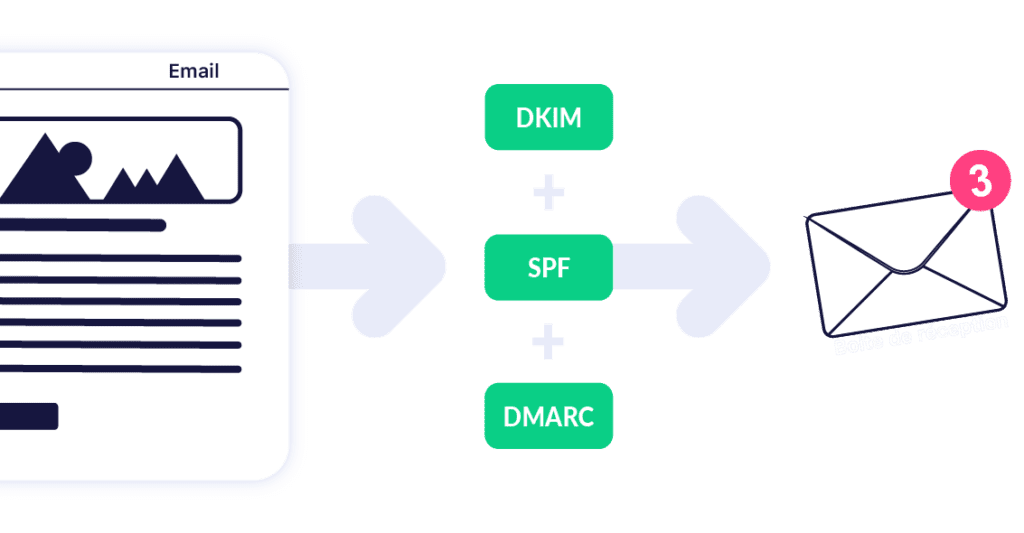
DKIM: What is it and why implement it to secure your e-mail deliveries?
In the world of digital marketing and email communication, deliverability and security are major issues. To ensure that your messages actually arrive in your recipients' inboxes - and not in the spam folder - the implementation of authentication mechanisms becomes essential. At Efidem, we favor one of the most effective and widespread, the DKIM, for DomainKeys Identified Mail.
What is DKIM?
The DKIM signature is an authentication protocol that allows a domain to add a digital signature to the emails it sends. Whether you send your messages via API or in manual mode via Snapshoot, This signature is inserted into the message header when the message is sent. On receipt, the receiving server can then check that the message has not been altered in transit, by comparing the signature with the original. public key published in the DNS of the sending domain.
In practical terms, this means that a domain (e.g. : your-company.com) can prove that he or she is the author of an e-mail, and that it has not been altered in transit. This is a sign of confidence not only for email providers (Gmail, Outlook, Yahoo...), but also for your recipients.
Why implement DKIM in your emailing strategy?
1. Improve deliverability your emails
By signing your e-mails with a DKIM-signature, you show e-mail providers that you are a reliable sender. This authentication enables you to reduce the risk of spam classification. Coupled with other protocols like SPF and DMARC, DKIM plays a central role in optimizing your sending reputation. To set it up, follow the instructions on this page.
2. Guarantee the’integrity your messages
Thanks to the DKIM signature and the DKIM key, the content of the email is protected: any modification between sending and receiving (for example by a malicious actor or a SMTP relay compromise) would invalidate the signature. This ensures that the message read by the recipient is exactly the one you sent.
3. Protect yourself against spoofing and identity theft
Visit spoofing email consists of sending messages by impersonating a trusted sender (such as a bank, a customer service department or a brand). By implementing this signature, you considerably reduce the risk of your domain being used for phishing attacks without your knowledge. This strengthens the security of your communications and protects your brand image.
4. Strengthen trust of your customers
By securing your e-mails with SPF and DKIM registration, you give your recipients a strong signal that your company takes communication security seriously. This can be particularly important for sensitive messages, such as order confirmations, sales reminders or electronic invoices.
How does DKIM authentication technically work?
Here is a summary of how it works:
-
- You generate a pair of keys (one private, one public).
-
- Visit private key is used by your sending server to sign emails.
-
- Visit public key is published in your domain's DNS, accessible by any receiving server.
-
- When an email is received, the recipient's server :
-
- retrieves the public key,
-
- checks the signature,
-
- validates the authenticity of the message.
-
- When an email is received, the recipient's server :
This verification is transparent to the end user, but crucial for spam filtering systems and the deliverability Email.
How do I set up DKIM email security?
DKIM and DMARC signatures are generally implemented at the level of your emailing provider or your server SMTP. At Efidem, In addition, we support our customers in the optimal configuration of their mailings: we generate the necessary keys, help to publish the right DNS record, and verify the correct signature of sent messages.
If you use our services SMTP mailings or our emailing APIs, a DKIM record is one of the parameters we can help you activate to improve the deliverability of your campaigns.
In a nutshell
The DKIM signature is a key element in securing and legitimizing your business emails. By implementing it, you reinforce the trust of your recipients, improve your deliverability, and combat the risk of identity theft. At a time when inboxes are under increasing scrutiny, this simple yet powerful measure has become a must.
Would you like to configure DKIM for your campaigns? Contact our Efidem teams - we'll help you set up a robust authentication strategy for your emails.