Sending High-Volume Emails: Essential Technical Prerequisites in 2026
Email remains one of the most widely used channels for businesses to communicate with their customers, prospects, members, or partners. Marketing campaigns, transactional notifications, order confirmations, reminders, invoices, security alerts, authentication codes: the uses of high-volume emailing are numerous and often critical.
But sending bulk emails in 2026 has little to do with emailing ten years ago. It's no longer enough to have a contact list, a sending tool, and a well-presented message. Email providers like Gmail, Yahoo, Outlook, and Orange now apply stricter filtering rules, with particular attention paid to domain authentication, sender reputation, list quality, and recipient behavior.
For companies that generate high-volume email marketing, the deliverability is therefore no longer a simple marketing subject. It's a technical, organizational, and strategic subject. An email can be correctly sent by a platform, accepted by the recipient server, but never arrive in the main inbox. It can be placed in spam, filtered by a security gateway, slowed down, rejected, or degraded due to insufficient reputation signals.
Here are the main prerequisites to master before sending high-volume emails.
1. Authenticate your domain for high-volume emailing
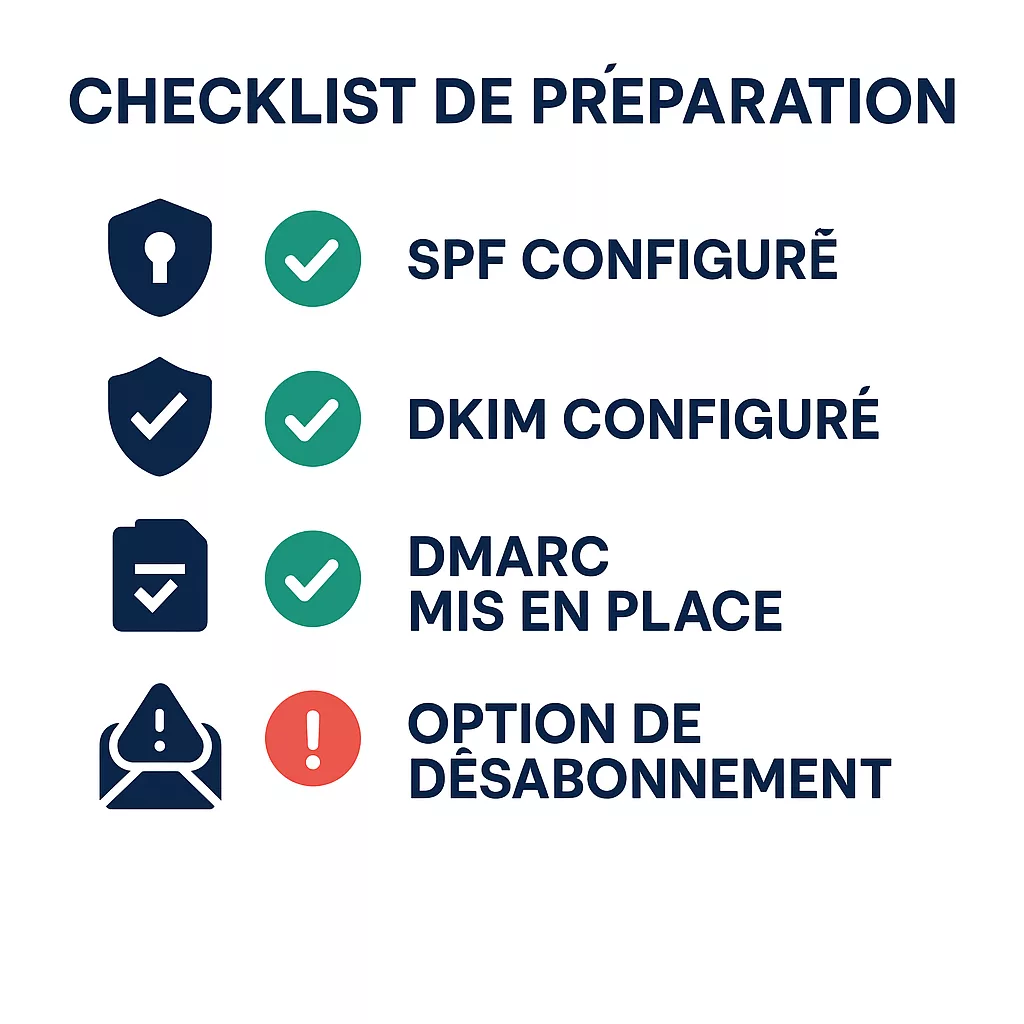
The first prerequisite for high-volume emailing concerns the authentication of the domain used to send emails. This has become essential to achieve good email open rates. The main mechanisms to implement are SPF, DKIM and DMARC.
SPF indicates which servers are authorized to send emails on behalf of a domain. DKIM adds a cryptographic signature to the message to prove that it has not been modified and that it genuinely comes from a legitimate sender. DMARC, in turn, defines a processing policy when SPF or DKIM are not aligned with the sending domain.
These three elements play a central role in the trust your emails receive. Without them, your messages can be considered suspicious, even if the content is legitimate. Major providers like Google and Yahoo now require bulk senders to adhere to precise authentication rules, including SPF, DKIM, DMARC, and proper management of sending domains.
For a company, this means that you should not send from a poorly configured, temporary, or unmanaged domain. The sending domain must be clearly identified, stable, authenticated, and consistent with the company's identity.
Understand that “delivered” does not mean “arrived in inbox”
This is one of the most important points to understand.
In sending tools, the “delivered” status generally means that the recipient server has accepted the message. In technical terms, this often corresponds to a positive response from the receiving server. However, this acceptance does not guarantee that the email has arrived in the recipient's main inbox.
After acceptance, the message can still be analyzed by various filters: anti-spam, antivirus, security gateway, internal company policy, mailbox rules, or the email provider's own algorithms. It can therefore be placed in junk mail, classified in a secondary tab, quarantined, or blocked downstream.
This is why deliverability is not just about the rate of technically accepted messages. It must be analyzed with several indicators: open rate, click-through rate, bounce rate, spam complaints, unsubscribes, recipient engagement, domain reputation, and behavior by email provider.
For companies that generate a lot of high-volume emailing, this distinction is essential. It prevents drawing incorrect conclusions and allows for addressing the real issues: list quality, reputation, content, frequency, segmentation, and technical configuration.
3. Mastering Sender Reputation
Each sending domain and infrastructure gradually builds a reputation. This reputation directly influences how email providers handle emails.
A good reputation is built on several positive signals: recipients opening emails, clicking, replying, saving messages, or regularly interacting with the brand. Conversely, certain signals can degrade reputation: spam complaints, high bounce rates, invalid addresses, too frequent sending, misleading content, old lists, or lack of consent.
Email providers pay close attention to user complaints. For example, Yahoo recommends keeping the complaint rate below 0.3% %, and Google states that bulk senders whose reported spam rate exceeds 0.3% % may face restrictions on their ability to resolve or mitigate issues.
In practice, this means that a company must not only aim to send more, but also to send better. Volumes must be controlled, campaigns segmented, and databases regularly maintained.
4. Separate marketing, transactional, and critical streams
Not all emails have the same purpose or the same level of criticality.
Email marketing sent to a large prospect base doesn't carry the same weight as a transactional email containing an invoice, an order confirmation, or a password reset link. Similarly, an OTP code or a security notification should be treated as a priority stream, with particular attention paid to its speed and reliability.
For this reason, separating streams is highly recommended. This separation can be done at the level of domains, subdomains, shipping addresses, IPs, or technical environments.
For example, a company might use a dedicated subdomain for its marketing campaigns and another for its transactional emails. This organization helps limit side effects. If a marketing campaign generates too high a complaint or bounce rate, it should not compromise the delivery of critical emails.
This separation also facilitates management. Teams can track performance by message type, apply different rules depending on the flows, and better understand the origin of any deliverability issues.
5. Improve the quality of contact databases
The quality of the list is one of the most crucial factors in the success of a high-volume email send.
An old, poorly qualified, or insufficiently maintained base can quickly degrade the sender's reputation. Invalid addresses generate bounces. Inactive contacts reduce average engagement. Recipients who don't recognize the sender may mark the message as spam. Duplicates and outdated data complicate campaign management.
First and foremost, before any important sending, it is therefore necessary to check several points: data origin, consent, collection date, recent contact activity, bounce history, unsubscribes, previous complaints, and segmentation relevance.
The goal is not only to reduce technical errors. It is also to send the right message to the right people. A smaller but better-qualified database will often produce better results than a massive, cold, and unengaged one.
For large volumes, data hygiene must become an ongoing process. Cleaning a database once a year is not enough. You need to track bounces, remove invalid addresses, isolate inactive users, manage unsubscribes, and avoid endlessly re-engaging contacts who are no longer responsive.
6. Provide a simple and compliant unsubscribe option
Unsubscribing is not just a regulatory obligation or a good marketing practice. It's also a strong signal for deliverability.
When a recipient no longer wants to receive your emails, they must be able to unsubscribe easily. If the link is missing, hidden, or too complicated, the user risks clicking “Report as spam.” For email providers, this action is much more negative than a standard unsubscribe.
Current requirements from major providers are moving in this direction. Yahoo, in particular, asks bulk senders to implement a functional unsubscribe mechanism, with a visible link in the message and prompt processing of requests.
From an operational standpoint, the company must therefore ensure that unsubscribe links function, that requests are properly recorded, that lists are synchronized, and that unsubscribed contacts are not mistakenly re-imported during a future campaign.
A good unsubscribe protects your reputation. It's better to cleanly lose an uninterested contact than to artificially keep an address that will degrade the performance of future sends.
7. Monitor indicators and react quickly
Visit deliverability is never permanently acquired. It evolves based on volumes, content, recipient reactions, changes in provider rules, and the quality of data used.
That's why companies that send a lot of emails must implement regular tracking. It's not enough to look at the number of emails sent or delivered. You need to track indicators by campaign, by recipient domain, by flow type, and by contact segment.
A sudden rise in bounces, a drop in Gmail opens, an increase in complaints, or a degradation on a specific domain must be analyzed quickly. The sooner a problem is detected, the easier it is to fix.
High-volume email deliverability must also incorporate technical feedback: SMTP codes, temporary errors, blocks, slowdowns, rejections, queuing, or specific responses from recipient servers. This information helps identify whether the problem stems from reputation, content, infrastructure, sending domain, or contact list.
Conclusion: Sending high-volume emailing is like managing an ecosystem.
In 2026, high-volume emailing SMTP or other cannot be approached as a simple routing operation anymore. Technical requirements, email provider policies, and recipient expectations necessitate a more structured approach.
To maximize the chances of reaching the inbox, you need to correctly authenticate your domains, separate your flows, maintain a healthy contact base, respect unsubscribe rules, monitor reputation signals, and precisely understand delivery statuses.
High-volume emailing performance therefore relies as much on infrastructure as on data quality and the relevance of the messages sent. A reliable sending platform is essential, but it must be accompanied by rigorous management and a true culture of deliverability.
For businesses that generate a lot of’emailing At high volumes, this support becomes a strategic advantage: it allows for securing important communications, preserving brand reputation, and sustainably improving campaign performance. Happy high-volume emailing to all, and let's respect the rules of CNIL !